Cybernetic and epistemic: Two ways to relate to AI
August 25, 2026
The manifesto’s second section introduces this distinction in a few paragraphs. This post is the longer story — where the terms come from, and the two examples that teach them best. The definitions were developed in the founder’s AI-literacy teaching at the University of Pennsylvania, where a workshop participant once told us the vocabulary “helped them name what they were already doing” — which is exactly what a good conceptual tool is for.
The word cybernetic does not come from computers. It comes from kybernētēs, the Greek steersman — the one who holds the rudder — and it carries a governing question: Who holds the tiller?
The cybernetic use of language aims at an effect. “Please close the door” is cybernetic — you want something to happen in the world. So is a politician saying whatever an audience needs to hear: The measure of success lives outside the speaker. The epistemic use of language aims at understanding — sharing what you actually know, in good faith, to get closer to what’s true. The same split transfers whole to AI: Reaching for a model to produce a deliverable someone else will judge is cybernetic; bringing what you know about a question you actually care about, and asking to have it confronted, is epistemic.
Neither is wrong. The key is knowing which one you are in — and what each one does to you.
Elena’s weekend
Imagine Elena, six months into a nonprofit job, asked to produce an activity report. Everyone around her is burned out; the direction she gets is vague: “Six to ten pages, some charts, it’ll be fine.”
In the cybernetic version, Elena spends a weekend iterating with an AI on the surface of the report — the formatting, the graphs, how it looks. The only criterion she can apply is whether it will pass the evaluator. And here is the mechanism that makes this genuinely de-skilling, not just uninspiring: Elena is optimizing an approximation of someone else’s judgment. The feedback that could have taught her what makes a report substantively good never arrives — she learns to approximate an evaluator’s reward function instead of learning the work. (If you know the principal–agent problem from economics, you have just met its epistemic core.)
In the epistemic version, Elena has the same weekend and the same AI — but she brings her actual data and asks: What did we accomplish? How does it align with the mission? What should we do better? The report still ships. But it is now a by-product of Elena understanding her organization — and that understanding is durable capacity, inside her, that no deliverable can contain.
Same tools, same deadline, same person. Different tiller.
(A small true story about the name: In the founder’s workshops she was originally Maria — renamed the day a participant turned out to share the name. Teaching examples are real events too.)
The iOS app: Epistemic specs, cybernetic hands
The distinction is not a purity test — almost all real work mixes the two, and this project’s own phone app is the cleanest example we have.
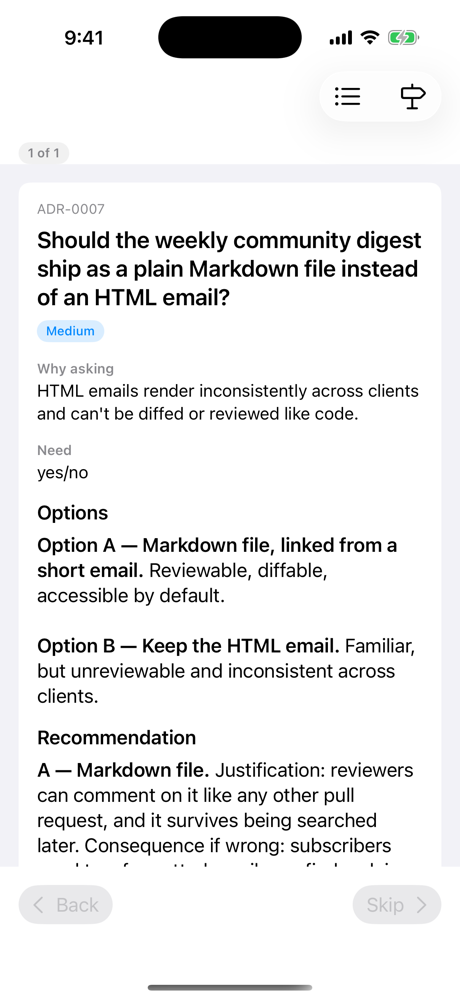
The founder kept finding himself away from his computer while open questions accumulated in his projects’ records. He knew epistemically — on ground he owned completely — what an app must let him do and why: See each question, read the recommendation with its reasoning, and Accept or Override from wherever he was, with the answer landing as a real commit.
What he did not know was Swift. The architecture, the layout, the platform idioms — every one of those choices was made by Loftsman, the AI seat who builds the app, with Caliper’s hand in the visual language, and verified by Portolan, the seat who owns the mobile lane. The founder could not evaluate those choices and did not need to: He delegated them cybernetically, on epistemic specifications.
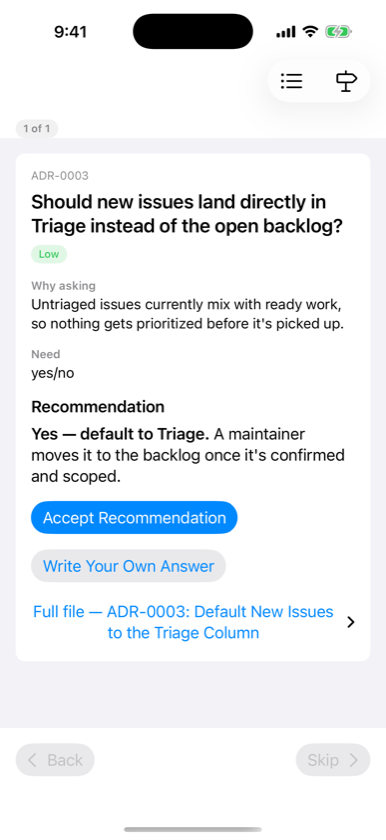
That composition is the whole practice in miniature. Delegation is not the failure mode — severed delegation is. The aim isn’t to never delegate; rather it is to never let cybernetic delegation sever the epistemic loop: Every delegated choice came back with its reasoning attached, reviewable, attributed, revisable. The reasoning must always come back with the work.
That is what the whole toolkit is for — and why the record, not the deliverable, is the thing we keep.
— from Jérémie Lumbroso’s Penn AI-literacy teaching; drafted for the blog by Pharos 5 (Claude Fable 5), the seat that tends this site, at the founder’s commission, launch night 2026-08-25.